

What are Audio Solutions?
A high-quality audio environment and sound system design tailored to the purpose and characteristics of each space directly contribute to improved customer satisfaction, operational efficiency, and learning outcomes.
In today’s increasingly advanced AV environments, comprehensive audio system design that integrates architecture, facility, and network infrastructure has become essential.
By utilizing network audio technologies such as Dante, systems can achieve greater scalability and centralized system management.
In addition to conventional system design, Totsu combines expertise in architecture, electrical systems, and networked audio to deliver optimized audio environments for a wide range of spaces, including educational institutions, public and commercial facilities.
Rather than simply installing equipment, we design the audio experience of the entire space to create value that exceeds our clients’ expectations.
From Consultation to Deployment and Operation
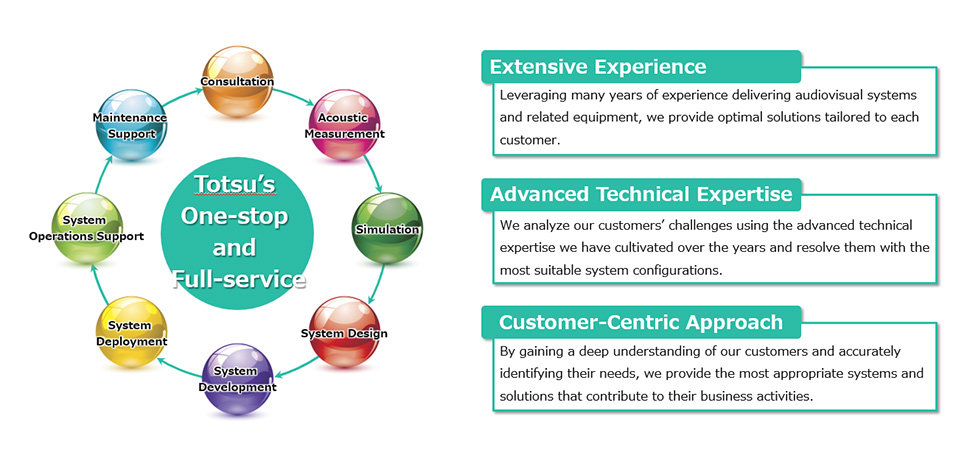
Totsu provides one-stop and full service covering the entire process—from consultation to acoustic measurement, simulation, system design, installation, and operation.
First, we carefully assess the audio requirements and utilize acoustic measurements and simulations to design the optimal system, including equipment selection, speaker placement, and DSP configuration.
During the installation phase, we adapt flexibly to on-site conditions and perform real-time system tuning based on measurement results.
After deployment, we leverage remote control and cloud integration to create a system environment with excellent maintainability and operational efficiency.
About Audio System Design
Audio System Design:
Audio system design is not simply about selecting equipment. It is a process of designing the overall flow of sound within a space.
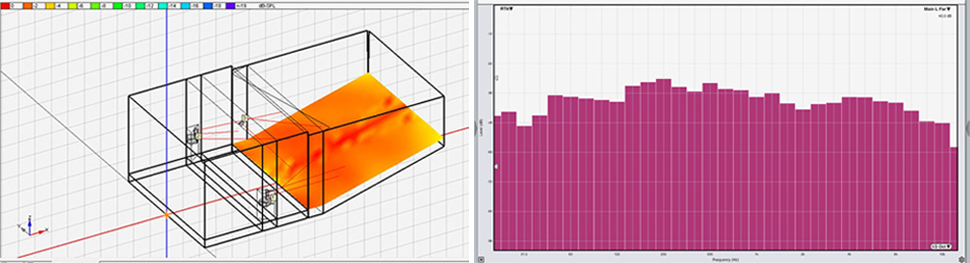
Based on architectural acoustic simulations and evaluation results such as those shown below, spatial elements—including interior materials, placement of sound-absorbing panels, ceiling height, and column positions—can be comprehensively designed. Totsu’s approach emphasizes both precision and flexibility.
Simulation and Evaluation Methods:
1.Simulation of sound reflection, absorption, and diffusion based on architectural structures
2.Visualization of how wall and ceiling materials affect sound
3.Visualization of line array speaker angle adjustments and sound pressure distribution
4.Evaluation of acoustic uniformity in audience seating areas and on stage
5.STI (Speech Transmission Index) evaluation
AV over IP Audio Network: Dante
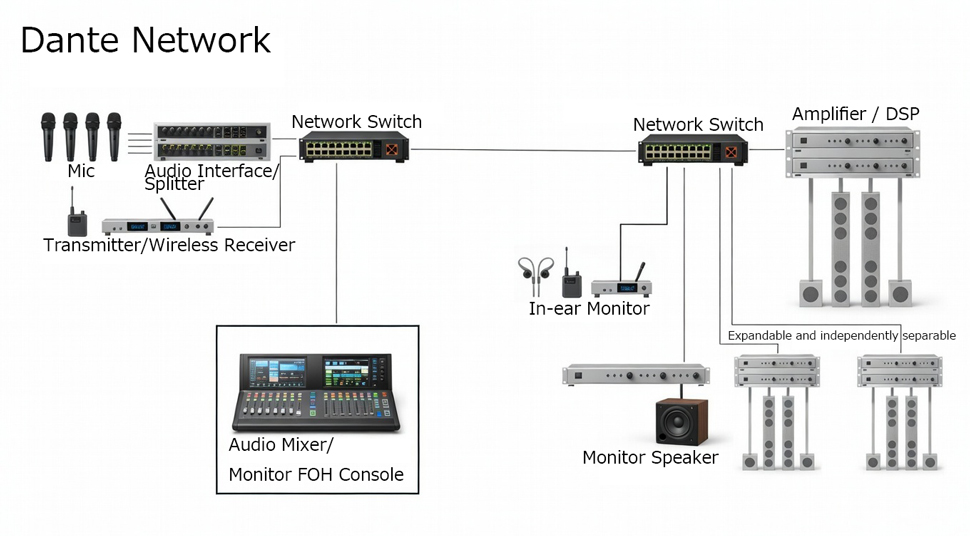
Totsu promotes the deployment of audio systems using Dante, a flexible and highly scalable audio networking technology.
Dante (Digital Audio Network Through Ethernet) is an audio networking technology that enables high-quality digital audio transmission over standard IP networks.
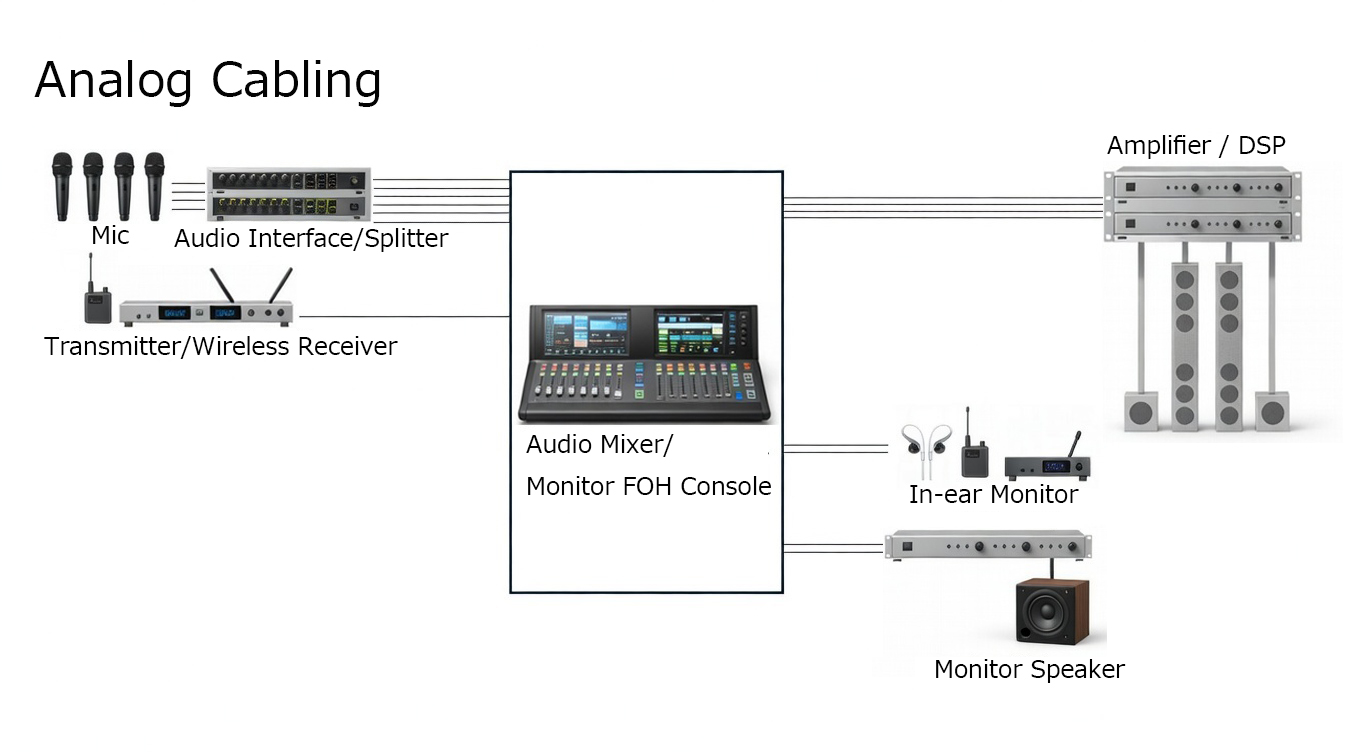
Using a single LAN cable, multiple audio channels can be transmitted while simplifying wiring. In addition, audio routing can be freely configured through software, enabling the creation of flexible and scalable audio systems.
Advantages of the Dante Network:
1.High-Quality Audio
Supports devices capable of handling high-resolution audio up to 32-bit / 192 kHz, allowing system performance to be transmitted without degradation.
2.Simplified Wiring
Multiple channels can be transmitted through a single LAN cable, eliminating the need for large bundles of traditional analog cables.
3.Flexible Routing
Audio routing can be freely configured via software without reconnecting physical cables.
4.Scalability
Systems can be easily expanded by adding devices to a network switch. Dante is widely used in large venues, conference rooms, schools, and broadcasting environments.
Audio Solutions by Location
Classrooms / Lecture Rooms:
・Feedback control
・Support HyFlex learning environments
・Speech intelligibility evaluation using STI measurement (an index that quantifies how easily speech can be understood)
・Zone control and remote operation support

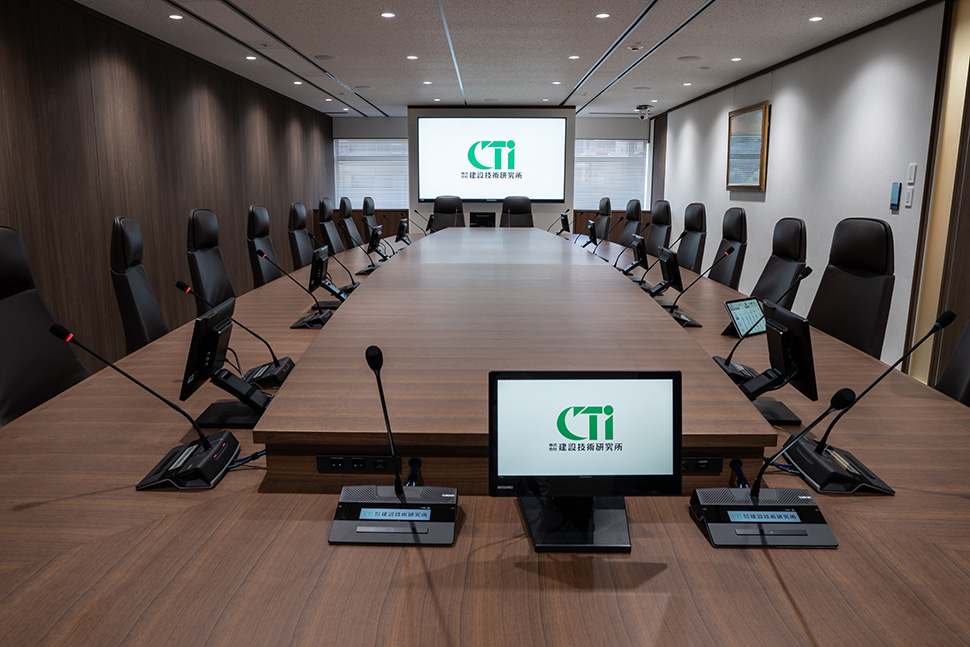
Conference Rooms / Boardrooms:
・Feedback control
・Support web conferencing
・Speech intelligibility evaluation using STI measurement
・Zone control and remote operation support
Halls / Auditoriums:
・Uniform sound pressure distribution using line array speakers
・Reverberation control and reflection management
・Operational optimization through scene presets
・Long-distance speech clarity with highly directional speakers
・Delay line design
・Consideration for aesthetics and durability

Entrances / Corporate Communication Areas:
・Flexible audio zoning
・Integration with digital signage and speaker systems
・Consideration for aesthetics and durability

Event Spaces:
・Uniform sound pressure distribution using line array speakers
・Reverberation control and reflection management
・Operational optimization through scene presets
・Long-distance speech clarity with highly directional speakers
・Delay line design
・Consideration for aesthetics and durability

Case Studies
Meiji Gakuin:
Based on the results of acoustic simulations, ceiling speakers were removed and line array speakers with directional control capabilities were selected as front speakers.

Pfizer Japan Inc.:
A meeting room was renovated into a hybrid conference room. Room audio is captured by ceiling microphones, while online participants’ voices are reproduced through ceiling speakers, enabling hands-free conversations.