

With its exceptional visual quality and commanding presence, an LED display immediately captures attention.
“We want to communicate our corporate image and message through impactful visuals.”
“We want to deliver visual content to large audiences effectively.”
“We want to maximize learning outcomes by presenting clear images and videos in classrooms.”
“We want to expand the possibilities of visual presentation and stage production.”
An LED display is a solution capable of meeting these diverse needs.
At the same time, many clients may have the following questions such as:
“Is it too early for us to install an LED display?”
“How does an LED display differ from an LCD video wall?”
“If we decide to install an LED display, which solution would be the best choice?”
On this page, we clearly explain:
• The differences between LED displays and LCD video walls
• The fundamental knowledge of LED display technology
• Real-world application examples
We also introduce Totsu Quality LED display solutions and what makes them unique.
Contents:
1.What Is an LED Display?
2.Differences Between LED Displays and LCD Video Walls
3.A Comprehensive Guide to LED Display Technology
(1)Terminology Overview
(2)Types of LED Technologies
(3)Advantages and Disadvantages of COB Technology
(4)Typical Installation Applications of LED Displays
4.Totsu Quality LED Display Solutions
– The Reason Clients choose Totsu for LED Displays–
1. What Is an LED Display?
An LED display is a large-scale visual display system that uses light-emitting diodes (LEDs) as its light source, characterized by its high brightness and vivid image quality.
Because each LED functions as an individual pixel, images remain clear and detailed even when viewed from a distance. By combining multiple panels, large-scale displays of various sizes and shapes can be freely configured.
2.Differences Between LED Displays and LCD Video Walls
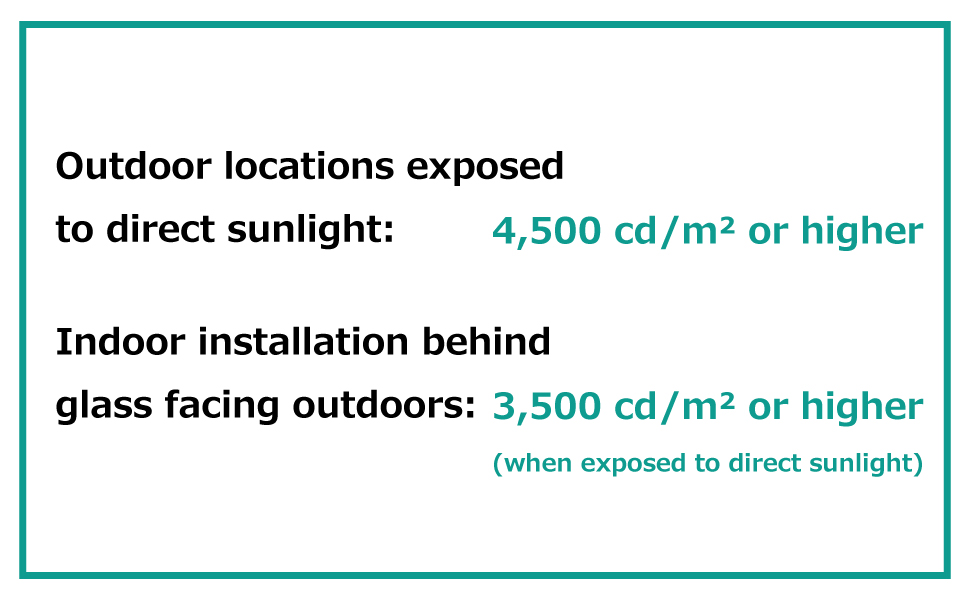
(1) Exceptionally Bright Displays
LED displays deliver outstanding brightness because each LED emits light directly.
| LED Display | LCD Video Wall | |
| Outdoor | 4000 ~ 8000cd/㎡ | 1000 ~ 2000cd/㎡ |
| Indoor | 600 ~ 800cd/㎡ | 300 ~ 500cd/㎡ |
(2) Suitable for Outdoor Installation
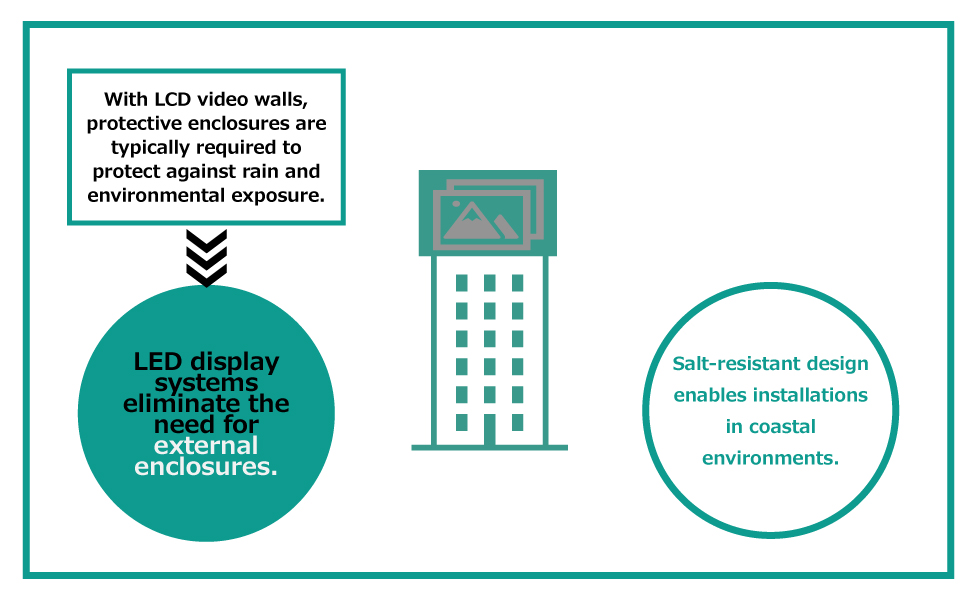
Outdoor LED display systems are designed for direct outdoor installation, featuring waterproof and dustproof panels and cabling.
(3) Bezel-Free for Seamless Large Displays
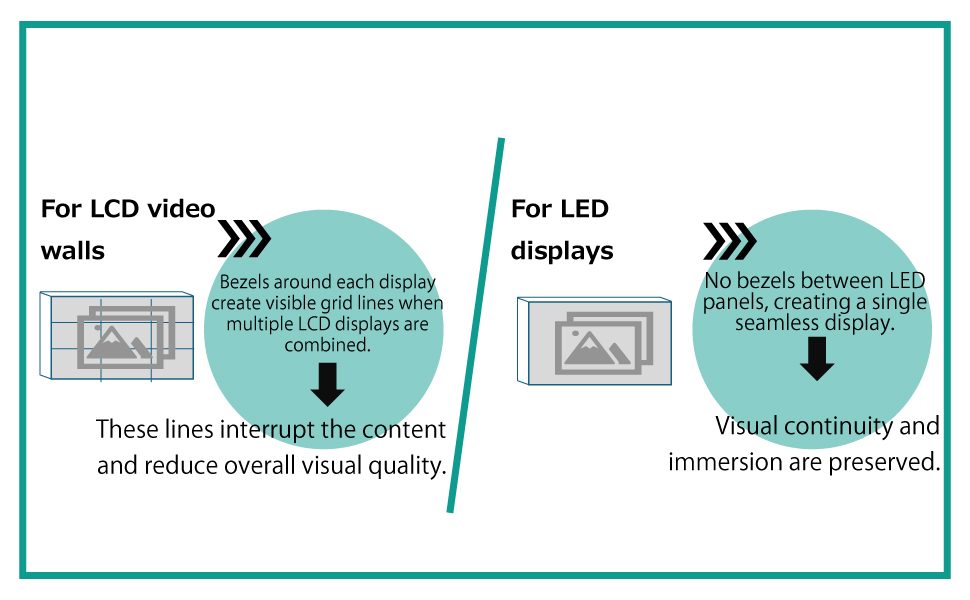
When building large screens, LCD video walls inevitably have bezels around each display.
In contrast, LED displays are completely bezel-free, delivering a seamless and unified visual experience.
(4) Consistent White Balance Over Time
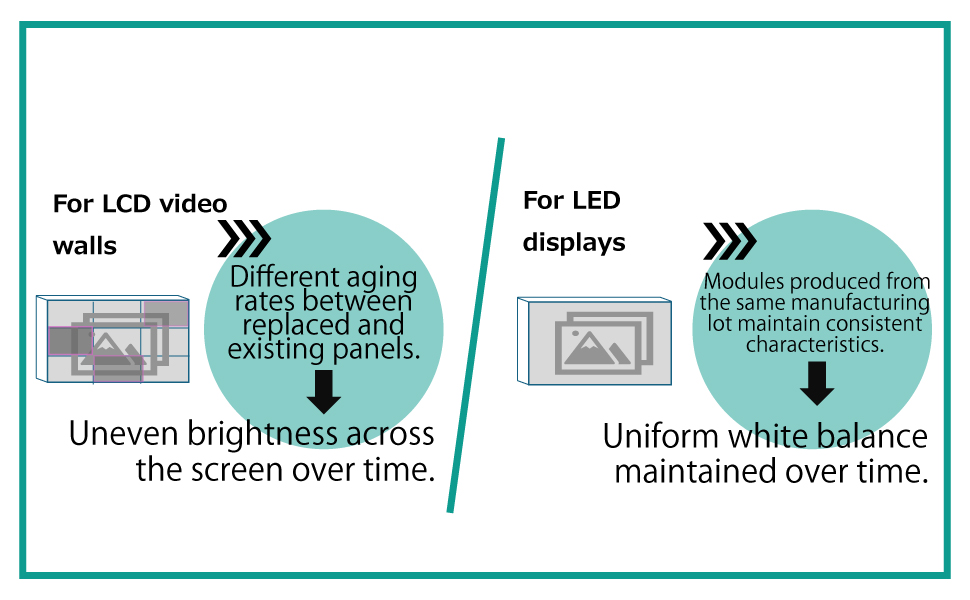
LED display systems maintain consistent white balance and uniformity by producing both active and spare modules within the same manufacturing lot.
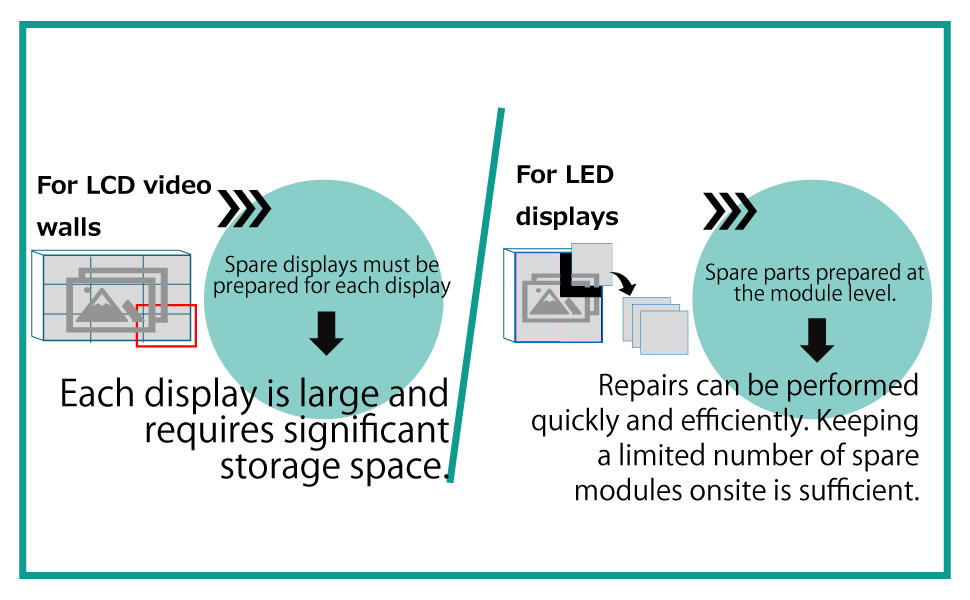
(5) Compact and Efficient Spare Parts Management
Spare parts for LED displays are prepared on a module basis, making storage compact and efficient.
In general, preparing spare modules equivalent to approximately 2% of the total display area enables immediate response in the event of a malfunction.
(6) A Wide Variety of Configurations
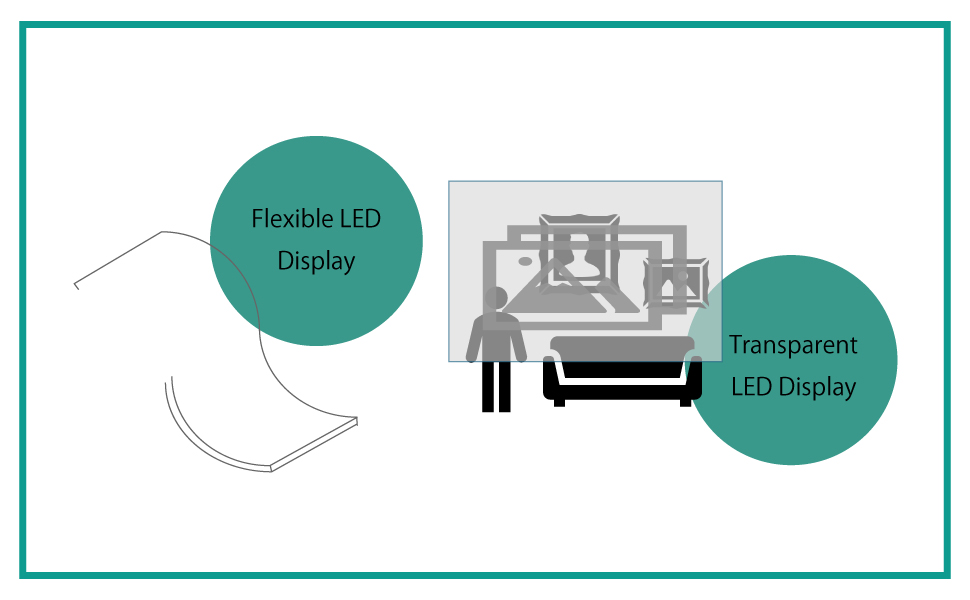
LED displays are available in a wide range of types, including vertical, horizontal, and lightweight, curved, and transparent designs, enabling flexible proposals for diverse environments.
Flexible LED displays can be wrapped around columns to display content on cylindrical surfaces, while transparent LED displays allow content to be shown across glass surfaces without blocking natural light.
3. A Comprehensive Guide to LED Display Technology
(1) Terminology Overview
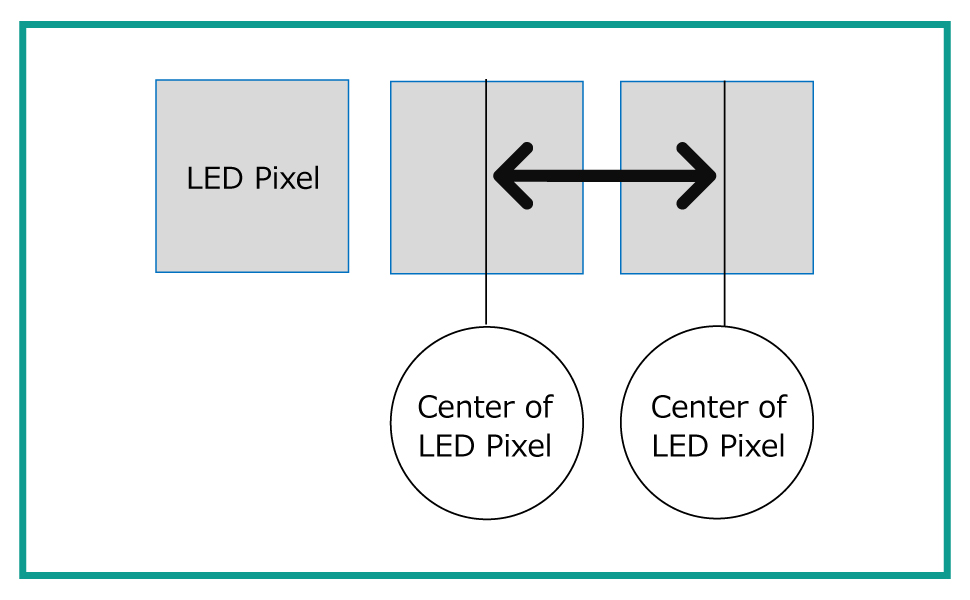
1. Pitch (Pixel Pitch)
The distance from the center of one LED pixel to the center of the adjacent pixel.
The smaller the pitch, the higher the display resolution.
For example: When the distance is 1.9 mm, the pixel pitch is referred to as P1.9.
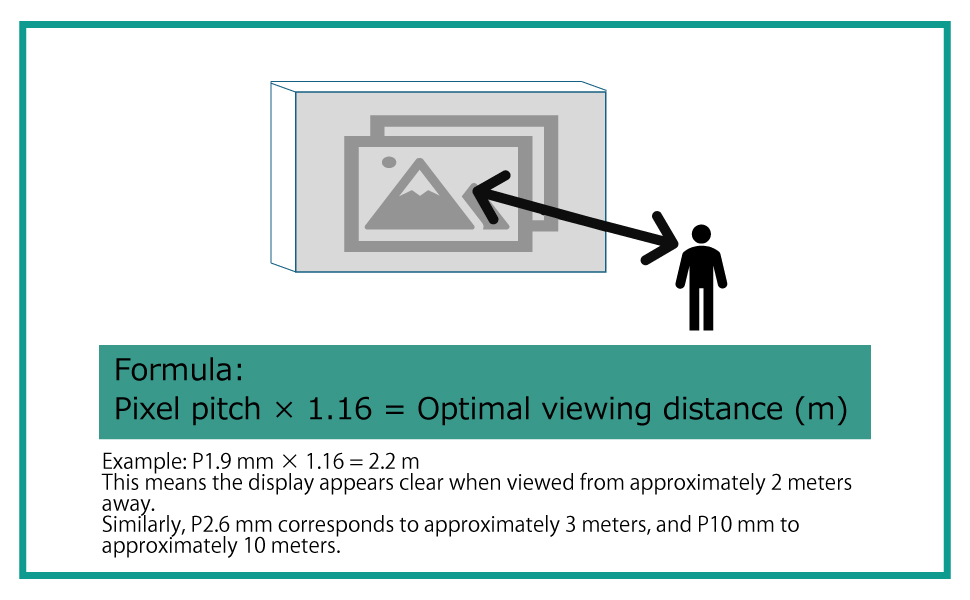
2. Optimal Viewing Distance
The recommended distance from the LED displays at which images appear clear and detailed.
This is a key factor when selecting the appropriate pixel pitch.
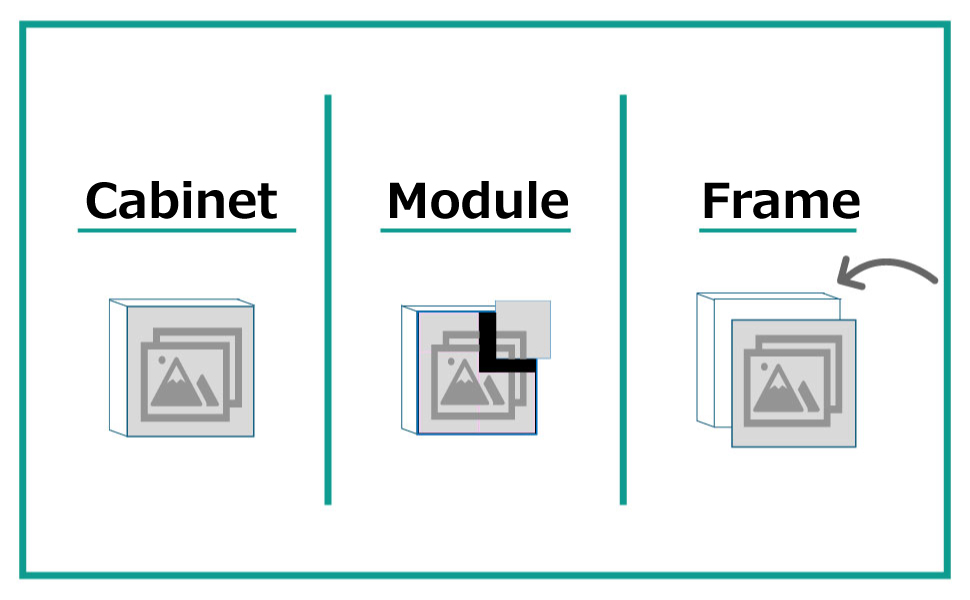
3. Cabinet, Module, and Frame
Cabinet:
The main structural unit of an LED display.
Modules are mounted inside the cabinet, and multiple cabinets are assembled together to create a large display surface.
Module:
A sub-panel on which the LED chips are mounted.
Since the display consists of multiple modules, only the affected module can be removed and repaired in the event of a failure.
Frame:
The structural base used to mount the modules.
During installation, the frame is first fixed to the substructure, wiring is arranged inside, and then the modules are mounted.
(2) Types of LED Technologies
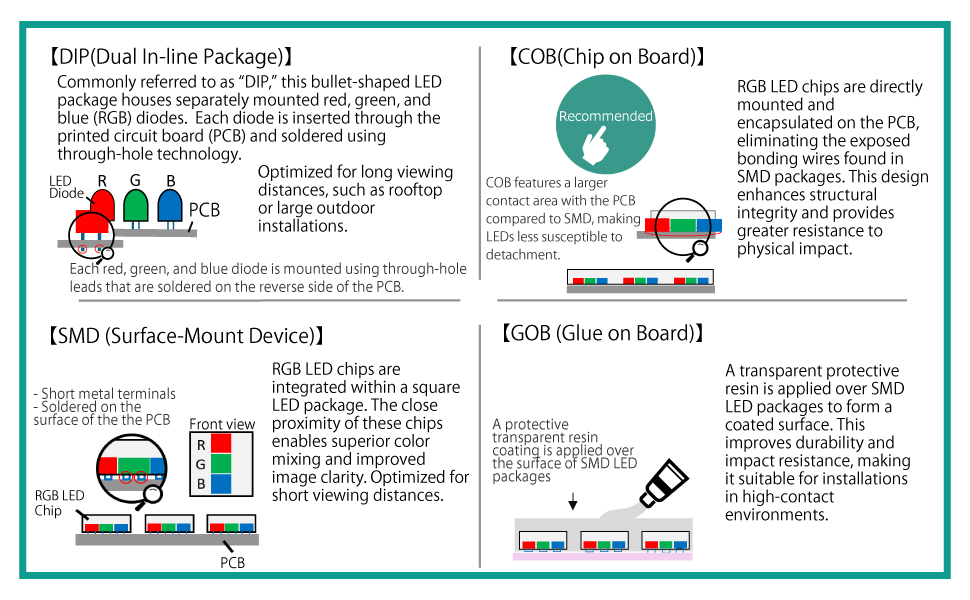
Previously, SMD was the dominant technology; however, COB has increasingly become the standard.
What is COB?
In COB (Chip-on-Board) technology, LED chips are mounted directly onto the circuit board and encapsulated as a single module. Because there are no exposed bonding wires, COB offers higher durability than SMD and is significantly less susceptible to physical damage or detachment.
(3) Advantages and Disadvantages of COB Technology
Advantages:
1.High-Density Mounting
Since LED chips are mounted directly onto the PCB, a smaller pixel pitch can be achieved.
2.Excellent Impact Resistance and Dust Resistance
The protective coating provides strong resistance to physical impact and dust.
The surface can be touched or tapped, enabling interactive applications.
3.Wide Viewing Angle
High light diffusion performance ensures a wide viewing angle, making the display easy to see even from oblique angles.
4.Low Heat Generation
Compared with SMD, COB provides better heat dissipation efficiency, enabling stable operation even during extended continuous use.
Disadvantages:
1.Higher Manufacturing Cost
COB requires high-precision mounting technology, and mass production has traditionally been more complex and challenging.
⇒However, advances in manufacturing processes are steadily improving scalability and cost efficiency.
2.Complex Repair and Replacement
Replacing individual LED chips is difficult, and maintenance requires unit-level replacement.
⇒In practice, however, panels are generally replaced with spare units, minimizing operational impact for end users.
(4)Typical Installation Applications of LED Displays
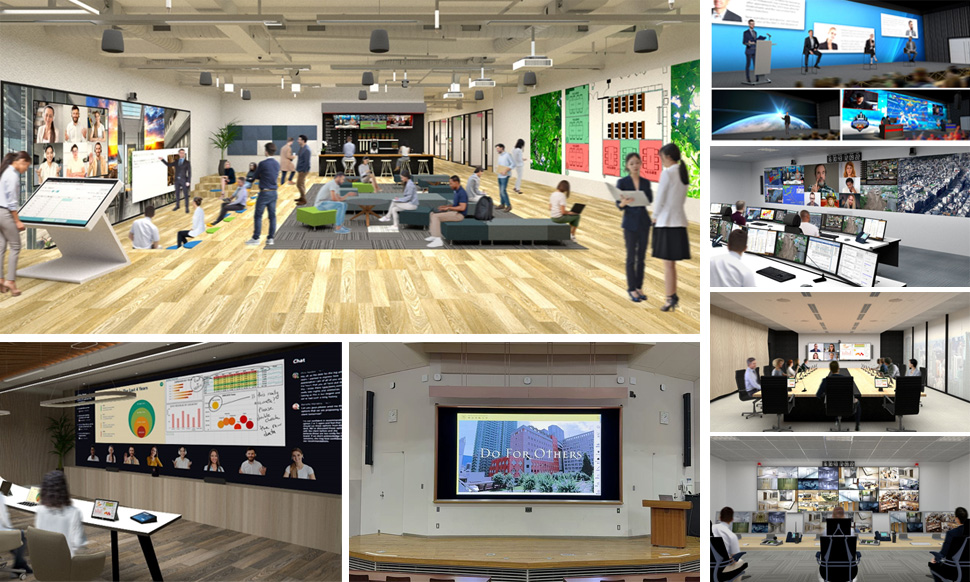
LED displays offer high design flexibility and are available in a wide variety of types, making them suitable for many different environments.
■Examples of Available Shapes
Vertical, horizontal, transparent, banner-type, circular, lightweight, etc.
■Installation Examples
Indoor:
Meeting rooms (standard and executive boardrooms), entrances, event spaces, studios, classrooms, digital signage boards, control rooms, disaster response centers, and more.
Outdoor:
Building facades, rooftops
4.Totsu Quality LED Display Solutions
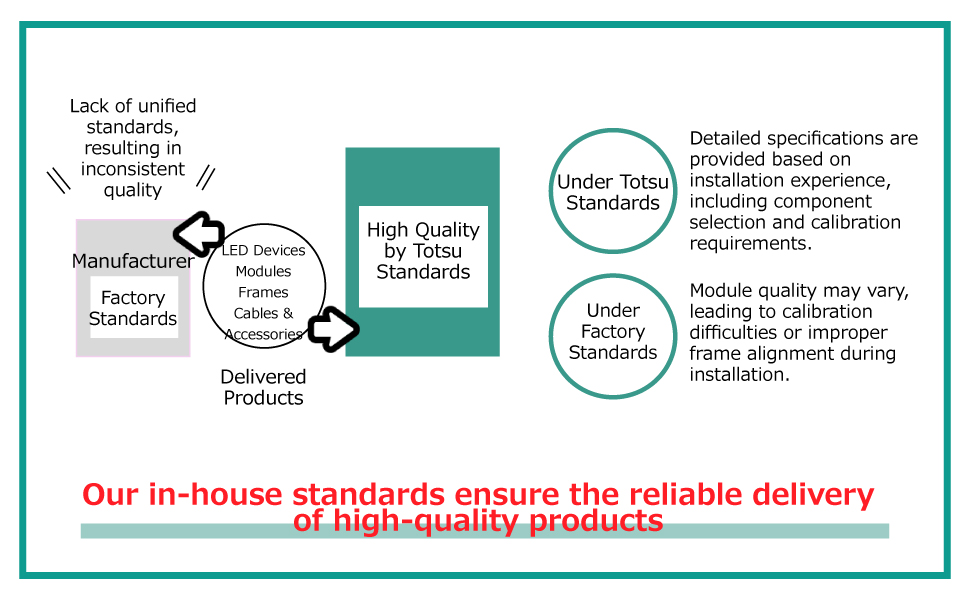
(1) Our In-House Quality Standards
Totsu has established our own quality standards to ensure the consistent delivery of reliable, high-quality products. From component selection to final inspection prior to shipment, we work closely with our partner factories to maintain stable and uniform quality.
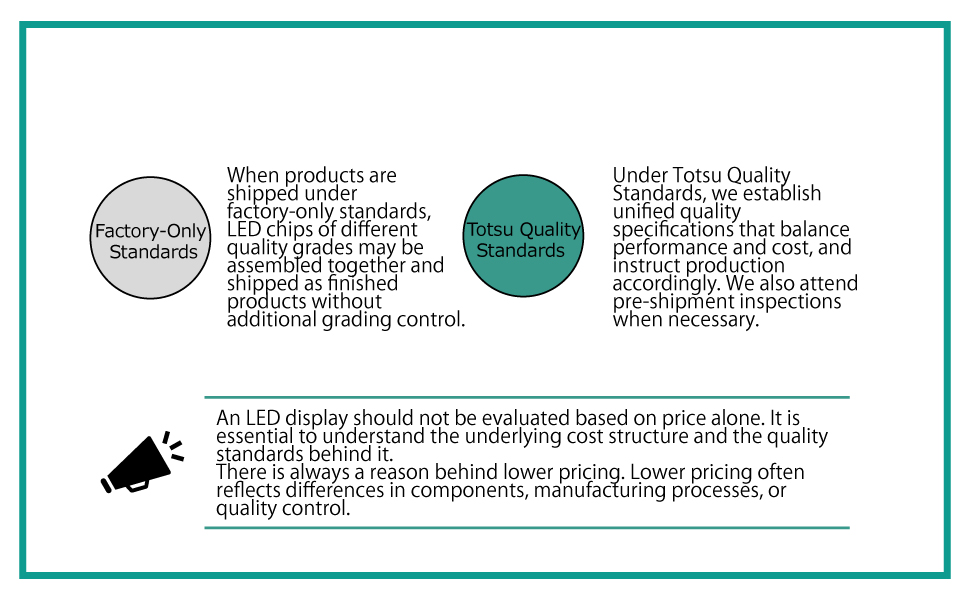
(2) Consistent Quality of LED Chips
LED chips are available in multiple quality grades, from premium to economy levels.
Totsu defines unified quality standards for production, carefully balancing performance and cost to ensure uniform quality across all products.
(3) Reliable Post-Installation Support
As a multi-vendor systems integrator of LED display solutions, we select, design, and install LED systems tailored to each client’s specific requirements.
This ensures not only optimal system selection, long-term reliability and complete peace of mind after installation.
(4) Optimal Product Selection as a Multi-Vendor Systems Integrator
As a multi-vendor systems integrator, we select the most suitable products from a wide range of manufacturers, ensuring optimal solutions for each client’s requirements.
Examples of manufacturers we handle:
SONY、NEC(SHARP)、LEDMAN、Unilumin、BARCO、SiliconCore、Leyard
In addition, we have accumulated extensive know-how through numerous installations and projects. If you have any questions, we would be pleased to provide detailed explanations while demonstrating actual products in our showroom.
We warmly welcome you to visit our showroom and experience the displays in person and quality of our LED display solutions firsthand.